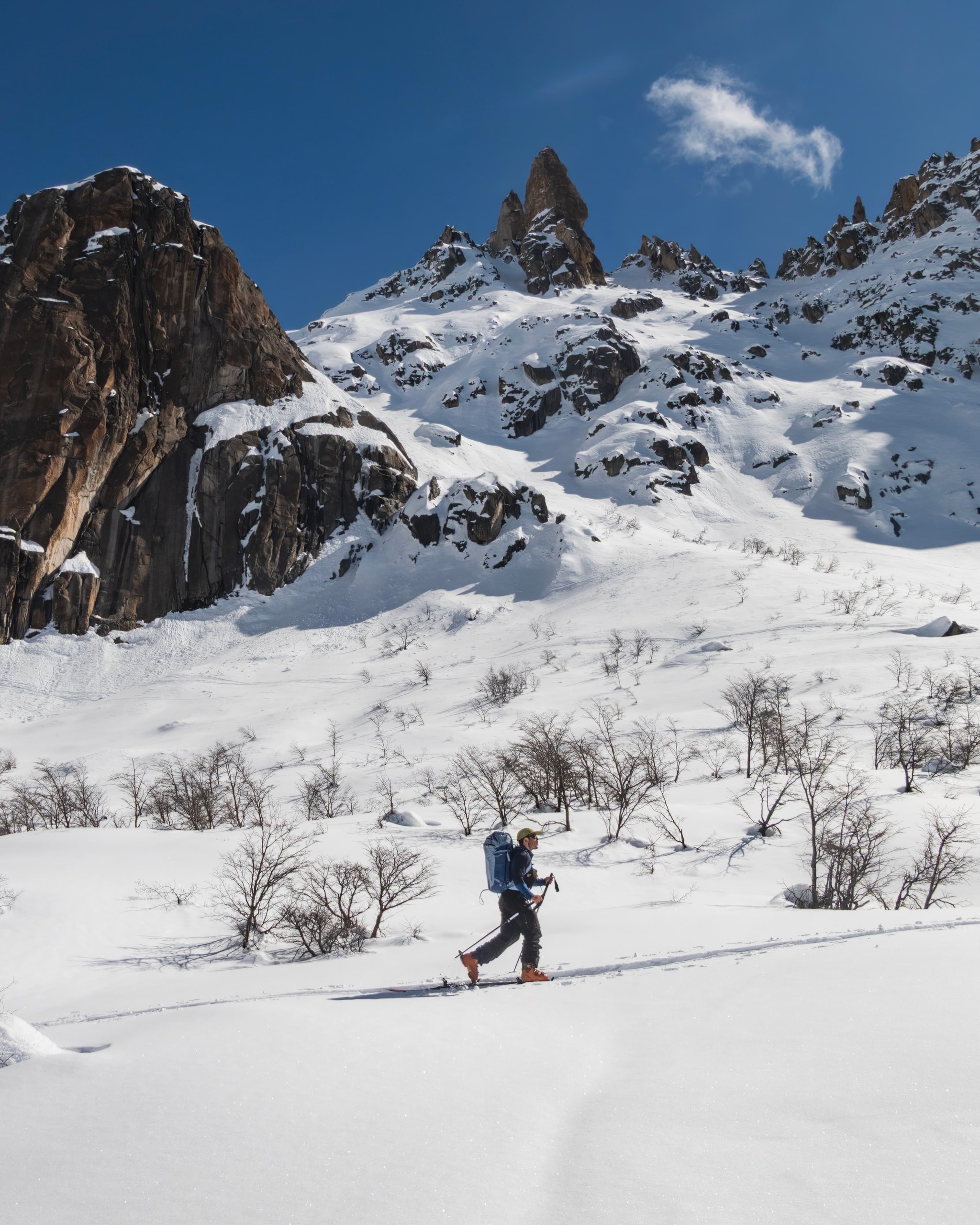
Skill and fitness by trip type, a quick self-check, and how to prepare — from the guides who match every group.
Short Answer
For most guided backcountry trips in the Andes, you need to be a strong intermediate or advanced skier who is comfortable off-piste in variable snow, and fit enough to climb 500 to 1,000 m (1,600 to 3,300 ft) a day for several days in a row.
You don't need to be an expert, but you need to have skied beyond the groomers before.
The exact level depends on the type of trip. Here is how we match guests to trips, and how to tell if you are ready.
By Trip Type
Level by Trip Type
| Trip type | Skiing level | Fitness | Backcountry experience | Example |
|---|---|---|---|---|
| Resort + sidecountry | Intermediate to advanced | Full days on the lifts | Not required | Andes Week, Portillo + Tres Valles |
| Progression camp | Intermediate to advanced | Good | Basic (beacon use, rescue basics) for the Chile camp | Chile Freeride Progression Camp, Women's Freeride Camp |
| Half resort, half touring | Strong intermediate to advanced | 500–1,000 m of climbing on touring days | Some touring days helpful | Nevados de Chillán & Corralco |
| Lift-free volcano touring | Strong intermediate to advanced | Several hours of climbing, days in a row | Recommended | Iconic Volcanoes |
Self-Check
A Quick Self-Check
You are probably ready for a backcountry trip if you can answer yes to most of these:
- Can you ski a black run in variable or heavy snow without stopping every few turns?
- Have you skied off-piste, in trees or in sidecountry before?
- Can you hike or skin uphill for 3 to 4 hours with a pack?
- Have you used an avalanche beacon, even in a course or a practice park?
- Are you comfortable on firm or icy snow early in the morning?
If you answered no to two or more, a resort trip with sidecountry or a progression camp is a better first step. That is not a downgrade: it is how most of our guests get ready for the volcanoes.
The Andes
What Makes Skiing in the Andes Different
- Altitude. The resorts near Santiago reach well above 3,000 m (9,800 ft). Give yourself a day to adjust before a big tour.
- Snow variety. In one day you can ski wind-packed snow, powder in a sheltered gully and spring corn. Being comfortable in all of them matters more than being fast.
- Big, open terrain. Slopes are often long and exposed. Guides choose the line, but you need to ski it in control.
- Fewer services. Backcountry zones are more remote than many in North America, with no ski patrol and limited cell coverage.
Preparation
How to Prepare
- Start 8 to 10 weeks before the trip. Hikes with a pack, stairs or an incline treadmill, and leg strength work like lunges and squats.
- Do at least one touring day at home if you are joining a touring trip. Learn transitions: skins on, skins off, switching modes.
- Take an avalanche course if you plan to keep skiing backcountry. A recognized level 1 course (such as AIARE 1 in the US) is a solid foundation.
- Ski off-piste every chance you get before the trip, even in-bounds.
Our Approach
How We Match Groups
We keep groups small, with a maximum of 4 guests per guide, and match people by level, pace and goals. Before you book, we ask about your experience, and if a trip doesn't fit, we'll tell you and suggest one that does. Plans adapt every day to weather, snowpack and the group.
FAQ
Frequently Asked Questions
Do I need to be an expert to ski backcountry in Chile or Argentina?
How much climbing is there on a touring day?
Do I need avalanche training?
Can snowboarders join backcountry trips?
What if I am not sure about my level?
Not Sure Which Trip Fits?
Tell Us About Your Skiing
Share what you ski at home and we'll recommend the right trip and dates.