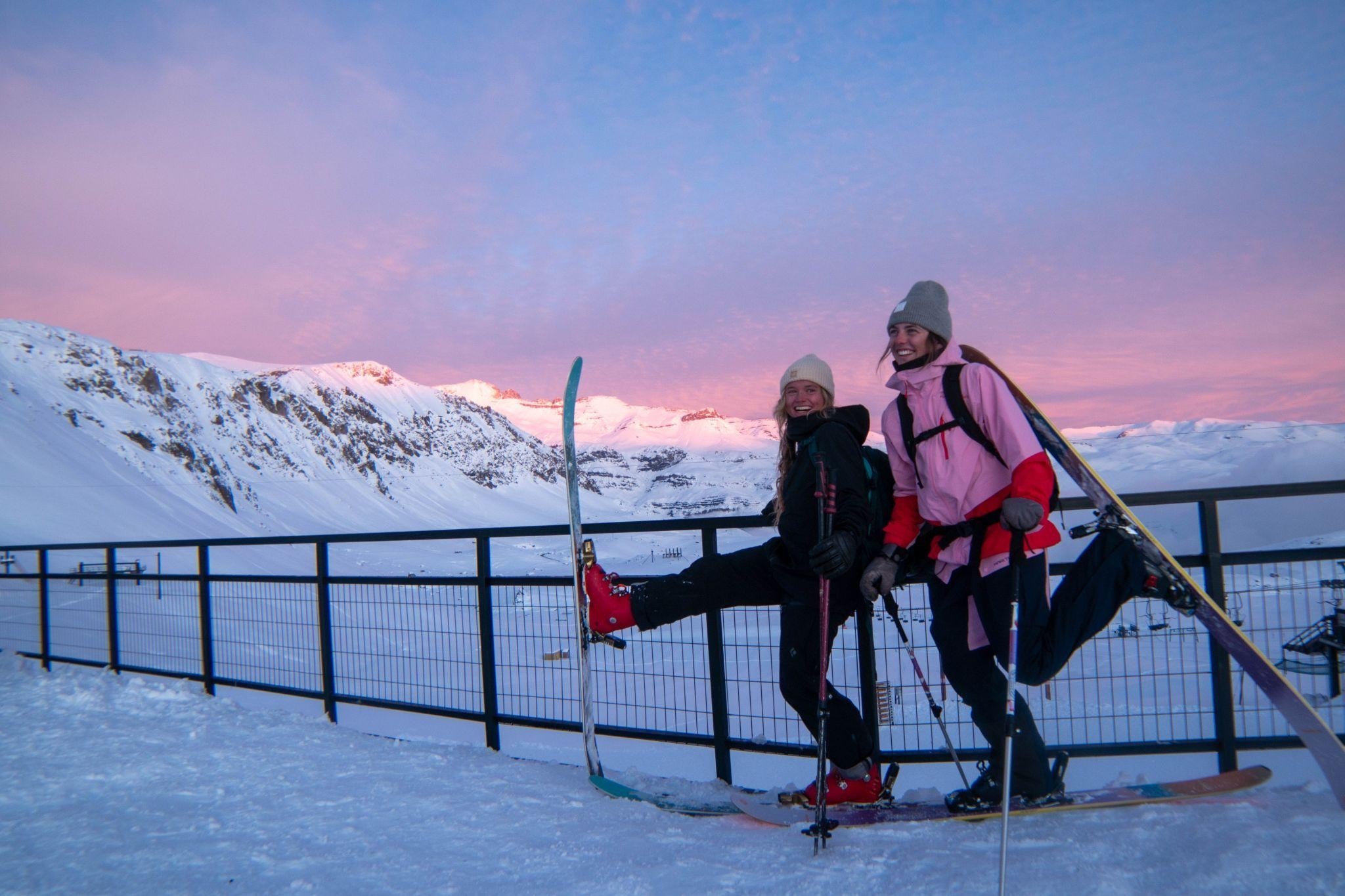
The Complete Andes Ski & Culture Guide
Ski regions, passes, flights, food, wine, asado cuts, mate, pisco sours β everything you need to know before your first trip to South America.
The Andes sit at the center of the ski world's best-kept secret. While Europe and North America dominate the headlines, Chile and Argentina offer world-class terrain, uncrowded mountains, and a mountain culture unlike anything north of the equator β and they do it right in the middle of northern summer. But skiing the Andes isn't just about the snow. The food, the wine, the rituals, the people β they're part of the experience, and they'll stay with you longer than any powder day. This guide is everything we wish someone had handed us before our first season here.
01 β When to Go
When Is Ski Season in Chile & Argentina?
The southern hemisphere winter runs from June through October, with peak snowfall between July and September. Chilean resorts typically open first β sometimes as early as mid-June β as the Pacific-facing slopes receive storm systems before they cross the cordillera. Argentine resorts follow a week or two later but often produce drier, lighter snow during peak season.
Jun β Early Jul
Opening Season
Chilean resorts open first. Early-season snowpack, fewer crowds, best value on lodging.
Jul β Sep
Peak Season
Best powder, consolidated snowpack, ideal for backcountry and freeride. July fills fast.
Oct
Volcano & Touring
Central resorts wind down. The real season opens on Chile's volcanoes: spring touring, ski mountaineering, and lines that don't exist anywhere else on earth.
El NiΓ±o Godzilla: the 2026 forecast
The term "Godzilla El NiΓ±o" β coined by NASA scientist Bill Patzert to describe outsized Pacific warming events β is back in circulation this year, and the ski world is paying attention. NOAA currently puts El NiΓ±o at a 61% probability from May through July 2026, with warm subsurface Pacific water building for five straight months and westerly wind anomalies already moving across the western Pacific.
For skiers, the picture is nuanced. In the central Andes (Santiago zone), El NiΓ±o typically brings more precipitation β which means more snow at elevation. El NiΓ±o years have historically opened earlier and built deeper bases in Chile's central resorts. The caveat is the snowline (isoterma): strong El NiΓ±o events can push rain higher up the mountain during storm events, producing variable conditions between snowfalls. In Patagonia (Bariloche), the pattern is less predictable β more precipitation likely, but snow level at elevation is less guaranteed than in the central Andes.
The honest summary: if a strong El NiΓ±o materializes, 2026 could be one of the better seasons the central Andes has seen in years β but plan with flexibility built in, follow local conditions closely, and lean on guide knowledge. We'll be tracking this through the season in our Field Notes newsletter.
Planning a July or August trip?Those months fill fastest. We recommend booking 8β12 weeks in advance.
Talk to Us02 β Ski Regions
Chile: Ski Regions, Terrain & Passes
Chile's ski terrain runs across three distinct zones, each with its own character, elevation, and access. The central resorts near Santiago are the most international and the most developed. The volcanic south is raw, uncrowded, and extraordinary. Together they represent one of the most varied ski environments in the world β within a single country.
Central Andes
Farellones & the Tres Valles
Valle Nevado, La Parva, and El Colorado β three resorts sharing a ridge an hour and a half from Santiago. Nearly 7,000 combined skiable acres and 30 lifts. Big, high, and accessible.
Central Andes
Portillo
One of the most iconic ski destinations in the world. Perched at 2,880m beside a frozen glacial lake at the Argentine border. Maximum 450 guests. Book early β very early.
Volcanic Zone β Southern Chile
Nevados de ChillΓ‘n
An active volcano, natural hot springs at the base, and some of the best backcountry terrain in the Andes. Post-ski soaks at altitude. Unlike anything in the Alps.
Volcanic Zone β Southern Chile
Corralco
AraucanΓa forest, a dormant volcano, and consistent powder. One of the least crowded quality ski areas in South America. Now on the Indy Pass.
Valle Nevado + La Parva: one ticket, 4,000+ acres
In 2023β24, Mountain Capital Partners acquired both Valle Nevado and La Parva, bringing them under common ownership for the first time. As of 2026, guests staying at Valle Nevado's hotels can ski both resorts on a single interconnected ticket β over 4,000 acres, 87 trails, and 30 lifts. This is the largest interconnected ski domain in the central Andes.
Season passes for North Americans
If you already hold a North American multi-resort pass, chances are you have access to the Andes. Here's the current situation:
Ikon Pass
No blackout dates at Valle Nevado. 5 days on Base Pass. The easiest way for an American skier to use their existing pass in South America.
Power Pass
Interconnected access across Valle Nevado and La Parva β the only pass that covers both under the new unified ownership structure.
Indy Pass
Covers Corralco in the volcanic zone. New for 2025 β the first Indy Pass resort in the Andes. Great add-on for a southern Chile itinerary.
The Epic Pass currently has no South American access. Portillo and the Argentine resorts (Bariloche, Chapelco, Cerro Bayo) are not on any multi-resort pass β day tickets apply.
03 β Argentina
Argentina: Bariloche & Cerro Catedral
If Chile's ski scene is defined by big open Andean terrain and proximity to Santiago, Argentina's is anchored by Bariloche β a Patagonian lake town that delivers one of the most complete ski experiences in the southern hemisphere. The skiing is excellent. The town is excellent. And the food and wine culture around the mountain is in a different league from anything in Chile's central zone.
Cerro Catedral, the resort, is 20 minutes from Bariloche. Over 100 runs, 1,200m of vertical, and a treeline that gives it a feel closer to the Rocky Mountains than the high Andes. Argentina's national ski team trains here. The Freeride World Tour has visited. And on a quiet weekday in August, you can find yourself alone on runs that would have lift queues half an hour long in Colorado.
"Bariloche is what would happen if you dropped a Swiss mountain village inside Patagonia and gave it world-class beef and one of the best craft beer scenes in South America."
Other Argentine resorts worth knowing
Chapelco (near San MartΓn de los Andes) is smaller and more relaxed β a great option for families or for those who want a less touristic Patagonia experience. Cerro Bayo (Villa La Angostura) is intimate and uncrowded, set on a lake with views that justify the trip alone. Las LeΓ±as is Argentina's most technically demanding resort β expert terrain at 3,430m, a vertical drop that rivals anything in North America, and notoriously unpredictable access. Not for first-timers, but unforgettable for the right skier.
Interested in skiing both Chile and Argentina?We design multi-country itineraries that make the most of both.
View Trips04 β Getting There
Flights, Transfers & Getting Around
Flying from North America
Most North American skiers fly into Santiago (SCL), which has direct connections from Miami, New York JFK, Dallas, Atlanta, Los Angeles, and other hubs. LATAM, American, Delta, and United all fly this route. Flight time from the East Coast is 10β11 hours. From the West Coast, around 12.
For Bariloche and Argentine Patagonia, you'll typically connect through Buenos Aires (EZE or AEP) for a domestic flight β or take the SKY Airline direct from Santiago.
Santiago to Bariloche: direct flight
SKY Airline operates direct flights between Santiago (SCL) and Bariloche (BRC) β approximately 1 hour 55 minutes, no stop in Buenos Aires required. Flights run 4 times per week (Tuesday, Thursday, Saturday, Sunday) during the ski season. This is a significant logistical advantage for a Chile-Argentina combined itinerary and saves 3β4 hours versus routing through Buenos Aires.
-
International flight β Santiago (SCL) Typically 1 checked bag included. Ski bag usually counts as one checked piece β confirm weight limit (23kg standard) with your carrier before packing.
-
Santiago β Central resorts (Valle Nevado, La Parva) 90-minute shuttle transfer from the city. Shared or private options available. We coordinate all transfers as part of guided programs.
-
Santiago β Bariloche, direct via SKY Airline 4 flights per week during ski season. Around 1h55. Book early β these fill quickly in peak season. Ski bag fee applies; book online in advance to avoid airport surcharges.
-
Santiago β ChillΓ‘n or Corralco Fly into ConcepciΓ³n (CCP) with LATAM or JetSMART β about 1 hour β then a 1.5-hour road transfer to the resort. Or take the overnight Pullman bus from Santiago (5 hours) and arrange a pickup.
Traveling with ski gear
On international flights, most carriers allow a ski bag within your checked luggage allowance. On domestic flights within Chile and Argentina β JetSMART, LATAM regional, SKY β there is typically an oversized sporting equipment fee of $30β60 USD per segment. Budget accordingly if you're moving between destinations. If you're renting gear on both ends, leaving your skis at home can save significant hassle and cost.
We coordinate all rentals, transfers, and logistics as part of every Esnativa program. Just bring your ski boots β everything else can be arranged on the ground.
05 β On the Mountain
Culture on the Mountain: What to Expect
The lifts open late
Don't show up at 8am expecting first tracks. Most Andean resorts open lifts at 9am or 9:30am. The mountain finds its rhythm mid-morning. Embrace it β a good breakfast and a slow start is part of how skiing works here.
Lunch is a two-hour event
In Chile and Argentina, lunch is the meal of the day. On the mountain, this often means a real sit-down, with wine, unhurried conversation, and no visible urgency to get back on the lifts. You can absolutely grab a quick bite and keep skiing. But if you're with locals, expect to be at the table until 3pm β and you'll be glad you stayed.
Altitude
Most Chilean resorts sit between 2,500m and 3,600m. Valle Nevado's summit is 3,670m. Portillo's base is 2,880m. Santiago, where most visitors arrive, is at 520m. The jump is real. Give yourself a day to acclimatize on arrival β drink water constantly, go easy on alcohol the first night, and descend if you get a headache at elevation. Don't push through altitude symptoms.
Weekend crowds
The central Santiago resorts are local mountains used by Chileans every weekend during winter. If your trip includes flexibility, weekday skiing (Monday through Thursday) is dramatically better β shorter queues, less traffic on the road up, and a more relaxed atmosphere on the mountain.
"There's no rush up here. The Andes will teach you to ski differently β and probably better."
06 β Chilean Food
Chilean Food: What to Eat
Chilean cuisine is grounded in honest, simple ingredients β and it's significantly better than its international reputation suggests. Here's the essential food vocabulary for an Andes ski trip.
Empanadas
The foundational snack of Chilean life. The classic is the empanada de pino β baked beef, onion, olive, hard-boiled egg, and raisins. The raisins sound wrong. They're not. Eat with pebre (a fresh salsa of tomato, onion, cilantro, and chili). Also look for empanadas de queso (cheese) and, in the south, empanadas de mariscos (seafood). They're appropriate at any time of day, including before 9am.
Sopaipillas
Fried pumpkin dough. The ideal mountain snack on a cold day β warm, dense, slightly sweet. Served at base area stands with pebre or mustard. Think of them as the Andes' version of a warm pretzel, and eat them as close to the fryer as possible.
Cazuela
A slow-cooked Chilean stew β beef or chicken, potato, corn, rice, and pumpkin in a light broth. One of the best aprΓ¨s-ski meals in existence. Simple, warming, and deeply Chilean. Order it at any traditional restaurant in the city or at mountain lodges.
Curanto
If you make it to southern Chile β ChiloΓ©, ChillΓ‘n, or anywhere in Patagonia β seek out a curanto. One of the most ancient cooking traditions in the Americas, dating back over 10,000 years: shellfish (clams, mussels), pork, chicken, chorizo, potatoes, and potato dumplings (chapaleles and milcao), layered and steamed together in a pit lined with hot stones and covered with giant nalca leaves. The result is a communal feast unlike anything else on earth. The indoor version (curanto en olla) is more accessible; the pit version is a full ritual. Either way, it's mandatory.
Chorrillana
A Chilean institution: a pile of fries topped with caramelized onions, thin-sliced beef strips, and a fried egg. Share it. Order it at a bar after skiing in Santiago or Bariloche. It's the correct post-mountain food.
The sea: Chile's greatest culinary advantage
Chile has one of the longest coastlines in the world β 6,400 km along the Pacific β and the cold Humboldt Current running offshore produces some of the most mineral-rich, biodiverse marine waters on the planet. Even if you're here to ski the mountains, the seafood culture is worth understanding. Here's what to look for:
| Name | What it is | How it's served |
|---|---|---|
| Locos | Chilean abalone β a large sea snail native to the Pacific coast. A delicacy, and one of Chile's most prized shellfish. | Locos con mayo: boiled, served cold with mayonnaise and salsa verde. Simple and extraordinary. |
| Machas a la parmesana | Razor clams baked with Parmesan, butter, and white wine. The definitive Chilean coastal starter. | Served in their shells, bubbling from the oven. Order them at any good seafood restaurant in Santiago or on the coast. |
| Erizos | Sea urchin β intensely briny and sweet. Chile's Humboldt Current produces some of the best in the world. | Served fresh in the shell with lemon. No adornment needed. Among the best and most affordable sea urchin on earth. |
| Paila marina | A hearty shellfish soup β mussels, clams, shrimp, and whatever the coast offers that day, in a fragrant broth. | Served piping hot in a clay pot. The ideal lunch in Santiago's Mercado Central before heading to the mountain. |
| Caldillo de congrio | Conger eel soup β Pablo Neruda wrote an entire ode to this dish. Chile's most poetic recipe. | Broth with eel, potato, onion, tomato, cilantro. Rich and deeply Chilean. Order it in any coastal city. |
| Centolla | Patagonian king crab from the channels of southern Chile. One of the great shellfish of the world. | Chupe de centolla: a creamy, baked king crab casserole. Only available in the south β worth the detour. |
If you're in Santiago with a free morning before heading to the mountain, go to the Mercado Central. It's a covered market in the city center with dozens of seafood stalls. Order a paila marina, a cold glass of Sauvignon Blanc, and you'll understand why Chileans consider themselves the seafood capital of the Americas.
Combining Santiago city days with mountain skiing?Our local team can point you to the right spots β no tourist traps.
Ask Us07 β What to Drink
Pisco Sour & What to Drink in Chile
The pisco sour
Chile's national drink and the correct aperitivo for any evening in the Andes. The Chilean pisco sour is clean and direct: pisco (a grape brandy produced in Chile's Norte Chico region), freshly squeezed lemon juice, sugar syrup, and ice, sometimes finished with a dash of Angostura bitters. It will arrive without asking at traditional restaurants before dinner. Order one. Then decide if you need another.
Chilean pisco is by law produced only in the Atacama and Coquimbo regions of Chile, from specific grape varieties. It's lighter and more citrus-forward than brandy, and in a well-made sour, the balance between acidity and sweetness is what makes it work. Don't over-complicate it β a good pisco sour at a Chilean table on a cold night after skiing is one of the better things in life.
Craft beer in Bariloche
Bariloche has the highest density of craft breweries per capita in Argentina β the result of German and Central European immigration to Patagonia in the 19th and 20th centuries. After a long day on Catedral, a cold local craft beer at a Bariloche bar is the correct choice. Look for labels like Berlina, Manush, and Blest. This is not casual β Bariloche craft beer is genuinely excellent.
Medialunas: the Argentine croissant
If you stay in Bariloche or Buenos Aires, breakfast will involve medialunas β the Argentine croissant. Smaller and sweeter than the French version, glazed with a light honey syrup, and consumed in quantities that would alarm a nutritionist. They come in two varieties: de manteca (butter, flaky, the superior option) and de grasa (lard, denser, more rustic). Both are correct. A plate of medialunas with a cortado at a Bariloche cafΓ© on a clear winter morning, with the lake visible through the window, is the right way to start a ski day in Argentina. Don't rush it.
Facturas and the Argentine bakery culture
The Argentine word for pastries is facturas β a word that also means "invoice," which tells you something about how seriously Argentines take their baked goods. Every town in Argentina has a bakery (panaderΓa) open early and late, serving medialunas, vigilantes (rectangular pastries with dulce de leche), and cannoli-style filled pastries. In Bariloche, the German-influenced bakeries add another layer β dark breads, strudel, and kuchen (fruit cakes) that reflect the Patagonian immigrant heritage.
Dulce de leche
Argentina runs on dulce de leche β a slow-cooked milk caramel that appears in virtually every dessert, spread on toast at breakfast, filled inside croissants, drizzled on ice cream, and eaten directly from a spoon when no one is watching. The Argentine version is richer and less sweet than anything labeled "caramel" in North America. Buy a jar at any supermarket before you leave. You'll need it when you get home.
Agua de vertiente
In Chile and Argentina, order sparkling water (agua con gas) or still (sin gas) without hesitation. The tap water in both countries is safe to drink in cities. In mountain lodges, still mountain water is often filtered and fine. Stay hydrated β altitude dehydrates faster than most skiers expect.
08 β The Ritual
Mate: Argentina's Essential Ritual
If someone offers you mate in Argentina β or in southern Chile β accept it. It's one of the most sincere acts of social inclusion in South American culture. You don't need to love it immediately. You just need to participate.
What it is
Mate (mah-teh) is a caffeinated drink made from dried yerba mate leaves, steeped in hot water and drunk through a metal straw (bombilla) from a shared gourd. It tastes like strong, grassy green tea with a pleasantly bitter edge. Some people love it immediately. Most people who spend a week in Argentina end up craving it.
The etiquette
Mate is passed clockwise around the group. You drink the whole gourd, then return it to the cebador (the person who refills it). Don't say "thank you" until you don't want any more β gracias means you're done. Don't move the bombilla. Don't complain about the temperature. These are the rules and locals will notice.
On the mountain
In Bariloche especially, you'll see people skiing with thermoses strapped to their packs and passing mate on the chairlift. This is completely normal. It's one of the more beautiful things you'll witness in South American ski culture. If someone offers you their gourd at the top of a lift, say yes.
09 β The Sacred Fire
The Argentine Asado
An Argentine asado is not a barbecue. Calling it a barbecue is like calling Cerro Catedral a ski hill. The asado is a ritual β a multi-hour event built around fire, beef, collective patience, and the understanding that what's on the grill is worth taking seriously. If you're in Bariloche for a week and you don't attend at least one proper asado, you've missed the center of the experience.
The key cuts
Argentine beef cuts have different names from North American ones. Here's everything you need to order confidently:
| Cut (Argentine) | What it is | Notes |
|---|---|---|
| Asado de tira | Short ribs | The backbone of any asado. Slow-cooked over coals, rich and fatty. Start here. |
| VacΓo | Flank steak | Slightly chewy with deep flavor. One of the most popular cuts at any parrilla. |
| EntraΓ±a | Skirt steak | Intense and beefy. Cook hot and fast. Order it at any parrilla β it's the crowd favorite. |
| Bife de chorizo | Strip loin (sirloin) | The classic steakhouse cut. Thick, juicy. Not the same as chorizo sausage β don't confuse them. |
| Ojo de bife | Ribeye | Fat-marbled, rich, the premium cut. Order it on a special occasion. |
| Mollejas | Sweetbreads | Served as a starter while the main cuts cook. Crispy outside, creamy inside. Don't skip them. |
| Morcilla | Blood sausage | Standard asado starter. Try it even if you're skeptical β the Argentine version is exceptional. |
| Chorizo | Pork sausage | Grilled until the skin cracks. Served in bread as a choripΓ‘n β Argentina's best street food. |
The rules
Never touch the grill. The asador controls the fire and this role is sacred β unsolicited grill advice is socially equivalent to adjusting someone's painting in their own home. Offer to help with other things: uncorking wine, cutting bread, setting the table. Eat slowly. There are always more cuts coming. The asado ends when the asador decides it ends.
10 β Wine
Wine by Region: Chile vs. Argentina
You're about to drink some of the best wine in the world at prices that will ruin European wine travel for you permanently. South America is one of the last places where world-class bottles are genuinely affordable at the restaurant level. Here's how to navigate both countries.
Chile
Maipo Valley
Cabernet Sauvignon · Carménère
Just south of Santiago. Chile's most prestigious red wine region β structured, dark-fruited Cabernets with Andean freshness. Concha y Toro's Don Melchor and Almaviva are made here. Any Maipo Cabernet on a restaurant list will be solid.
Chile
Casablanca & San Antonio
Sauvignon Blanc Β· Chardonnay Β· Pinot Noir
Cooled by Pacific fog. Chile's best whites β crisp, saline Sauvignon Blancs that rival New Zealand at a fraction of the cost. Order one with ceviche or seafood. Perfect match.
Chile
Colchagua & Cachapoal
Carménère · Syrah · Cabernet
Chile's answer to Napa. Where CarmΓ©nΓ¨re β essentially extinct in Europe after phylloxera β found its permanent home. Ripe and powerful. Great with red meat. Look for Lapostolle, Montes, VIK.
Argentina
Mendoza
Malbec Β· Cabernet Franc Β· Bonarda
The reason Malbec exists as a premium variety. High-altitude viticulture (750β1,500m in LujΓ‘n de Cuyo and Valle de Uco) produces extraordinary color, density, and freshness. Achaval Ferrer, Zuccardi, Catena Zapata. Order with your asado β this is the correct pairing.
Argentina
RΓo Negro & NeuquΓ©n (Patagonia)
Pinot Noir Β· Sauvignon Blanc Β· Malbec
The local wine region for Bariloche. Wind-battered Patagonian steppe produces wines with high acidity and extraordinary aromatics. Humberto Canale is the historic producer. A Patagonian Pinot Noir with Patagonian lamb is a combination worth building a trip around.
Argentina
Salta (Northwest)
TorrontΓ©s Β· Malbec
Some of the highest-altitude vineyards in the world (up to 3,000m). TorrontΓ©s is Argentina's unique white β floral, aromatic, unlike anything else. Not widely available in Bariloche restaurants but worth ordering if you see it.
At a Bariloche parrilla, a solid Malbec will cost $12β20 USD. Something excellent: $30β40. You are in good hands at every price point. Ask your waiter what's local β Patagonian bottles travel well.
11 β Before You Go
10 Things to Know Before Your First Andes Ski Trip
The practical details β kept short.
| 01 | Sunscreen is non-negotiable. High-altitude UV in the Andes is intense. Above 3,000m with snow reflection, sunburn happens fast β even on overcast days. SPF 50 minimum. Reapply every two hours. Your face will send you a message the next morning if you ignore this. |
| 02 | The altitude is real. Santiago is at 520m. Valle Nevado's summit is 3,670m. Drink water from the moment you land. Go easy on alcohol at elevation on your first day. If you get a bad headache above 3,000m, descend β don't push through it. |
| 03 | Weekend crowds at central resorts. Santiago's central resorts (Valle Nevado, La Parva, El Colorado) are local mountains for Chileans. Weekends are busy β on the road up, at the ticket window, and on the lifts. Weekday skiing is a different experience. |
| 04 | Cash still matters. Card acceptance has improved significantly, but mountain restaurants, shuttle drivers, and smaller ski areas often prefer cash. Bring some USD or exchange to local currency at the airport on arrival. |
| 05 | Lifts run until ~5pm. Most resorts close operations around 5pm. Plan your last run accordingly, especially if you need to arrange transport back to the city. |
| 06 | Learn three things in Spanish. "ΒΏDΓ³nde estΓ‘...?" (Where is...?), "La cuenta, por favor" (The check, please), and "Una copa mΓ‘s" (One more glass). The last one is the most frequently useful. |
| 07 | Travel insurance: read the fine print. Make sure your policy specifically covers backcountry skiing and helicopter evacuation. Many standard travel insurance policies exclude off-piste skiing by default. This is not a detail to skip. |
| 08 | Tipping. In Chile, 10% is standard and often not included in the bill. In Argentina, the same β but check if "servicio" is already charged. Tip your shuttle drivers and rental shop staff. It matters. |
| 09 | Book Portillo early. Portillo operates with a maximum of 450 guests. July and August weeks sell out months in advance. If Portillo is on your list, plan with serious lead time. |
| 10 | Slow down. The biggest mistake North Americans make in the Andes is trying to ski it like a Vail week β maximum vertical, lift to lift, ski-boot lunch. The better version is slower: a real lunch, wine at altitude, conversation with the person next to you on the gondola, and a last run in late afternoon light that takes your breath away for reasons that have nothing to do with the altitude. |
12 β FAQ
Frequently Asked Questions
When is the best time to ski in Chile and Argentina?
The ski season runs from June through October. July and August are peak season β most consistent snowfall and best powder conditions. September delivers longer days and excellent spring skiing. October sees central resorts closing but opens the real season on Chile's volcanoes: ski mountaineering, touring, and lines that don't exist in any other window.
Can I use my Ikon Pass in the Andes?
Yes. The Ikon Pass provides 7 days at Valle Nevado with no blackout dates (5 days on the Base Pass). Valle Nevado is now interconnected with La Parva under the same ownership, giving Ikon holders access to over 4,000 acres. The Epic Pass currently has no South American access. Corralco is on the Indy Pass for 2 days.
Is there a direct flight from Santiago to Bariloche?
Yes. SKY Airline operates direct flights between Santiago (SCL) and Bariloche (BRC), 4 times per week during ski season (Tuesday, Thursday, Saturday, Sunday). Flight time is approximately 1 hour 55 minutes. This is the most efficient way to combine a Chile and Argentina ski itinerary without routing through Buenos Aires.
What skill level do I need?
Esnativa designs programs for all abilities. For guided backcountry, we recommend being comfortable linking parallel turns on blue/red terrain without effort. For resort programs, beginners and intermediates are welcome β we build itineraries that combine lessons with progressively more challenging terrain across the trip. Attitude and fitness matter as much as raw technique.
Is backcountry skiing in the Andes safe?
With the right guides and gear, yes. All Esnativa guides are AMGA-, IFMGA-, or ACGM-certified avalanche specialists. We never leave resort boundaries without assessing the current avalanche bulletin and snowpack. Andean avalanche patterns behave differently from European conditions β another reason local expertise matters here more than almost anywhere.
What if snow conditions are poor?
We move. If one destination isn't delivering, Esnativa has the flexibility and the relationships to chase better conditions β sometimes to another zone, sometimes to another country. Operating in both Chile and Argentina gives us more options than almost any other operator in South America. Our goal is to get you skiing well, not to follow a fixed itinerary on paper.
Do you guide snowboarders as well as skiers?
Yes. We guide both skiers and snowboarders in resort and in the backcountry (splitboard). The only requirement is that your level matches the terrain for your chosen program.
What is El NiΓ±o Godzilla and will it affect skiing in 2026?
"Godzilla El NiΓ±o" is the name for an unusually strong El NiΓ±o event. NOAA currently puts El NiΓ±o at a 61% probability for MayβJuly 2026, with warm Pacific subsurface water building for five consecutive months. For the central Andes, a strong El NiΓ±o typically means more precipitation, earlier openings, and deeper bases. Historically, El NiΓ±o years have seen Valle Nevado open with 2m of base by late June. In Patagonia and Bariloche, the pattern is less predictable β more rain is likely but snowline at elevation is a variable. We'll publish our full 2026 seasonal forecast in the May Field Notes newsletter.
How far in advance should I book?
For multi-day programs we recommend booking 8β12 weeks ahead, especially for July and August. Portillo requires significantly more lead time β weeks in July sell out months before the season. A 50% deposit is required at booking, with the balance due 5 weeks before departure.
Ready to Go
Plan Your Andes
Ski Adventure
Tell us your dates, your level, and how much of this guide excited you most.
We'll build the right trip around you.

