Short Answer
The best time to ski tour Chile's volcanoes is from mid-September to October, when the snow turns to spring corn and the weather settles. You need to be a strong intermediate or advanced skier with good touring fitness, a full touring or splitboard setup and avalanche gear, and you should go with a certified guide.
The volcanoes of the Araucanía region, roughly 650 to 800 km south of Santiago, offer something few places in the world can: long, open descents on perfect cones, with smoking craters, araucaria forests and hot springs at the end of the day.
Part 01
The three classics
| Volcano | Elevation | What makes it special |
|---|---|---|
| Villarrica | ~2,850 m / 9,340 ft | Active crater, views over Pucón and the lakes, the most famous descent in Chile |
| Llaima | ~3,125 m / 10,250 ft | Big, remote and wild, with long fall lines |
| Lonquimay | ~2,865 m / 9,400 ft | Accessible from the Corralco area, a great first volcano |
Part 02
When to go
The resorts near Santiago get the deepest snow in July and August, but the volcanoes are at their best in spring. From mid-September to October, the snow follows a freeze-thaw cycle: firm in the early morning, then softening into smooth corn by late morning. Timing the descent to that window is the key to a great day.
Winter storms in July and August can bring powder to the volcanoes, but also strong wind, ice and short days. That is why our Iconic Volcanoes trip runs from late September into October.
Part 03
What a volcano day looks like
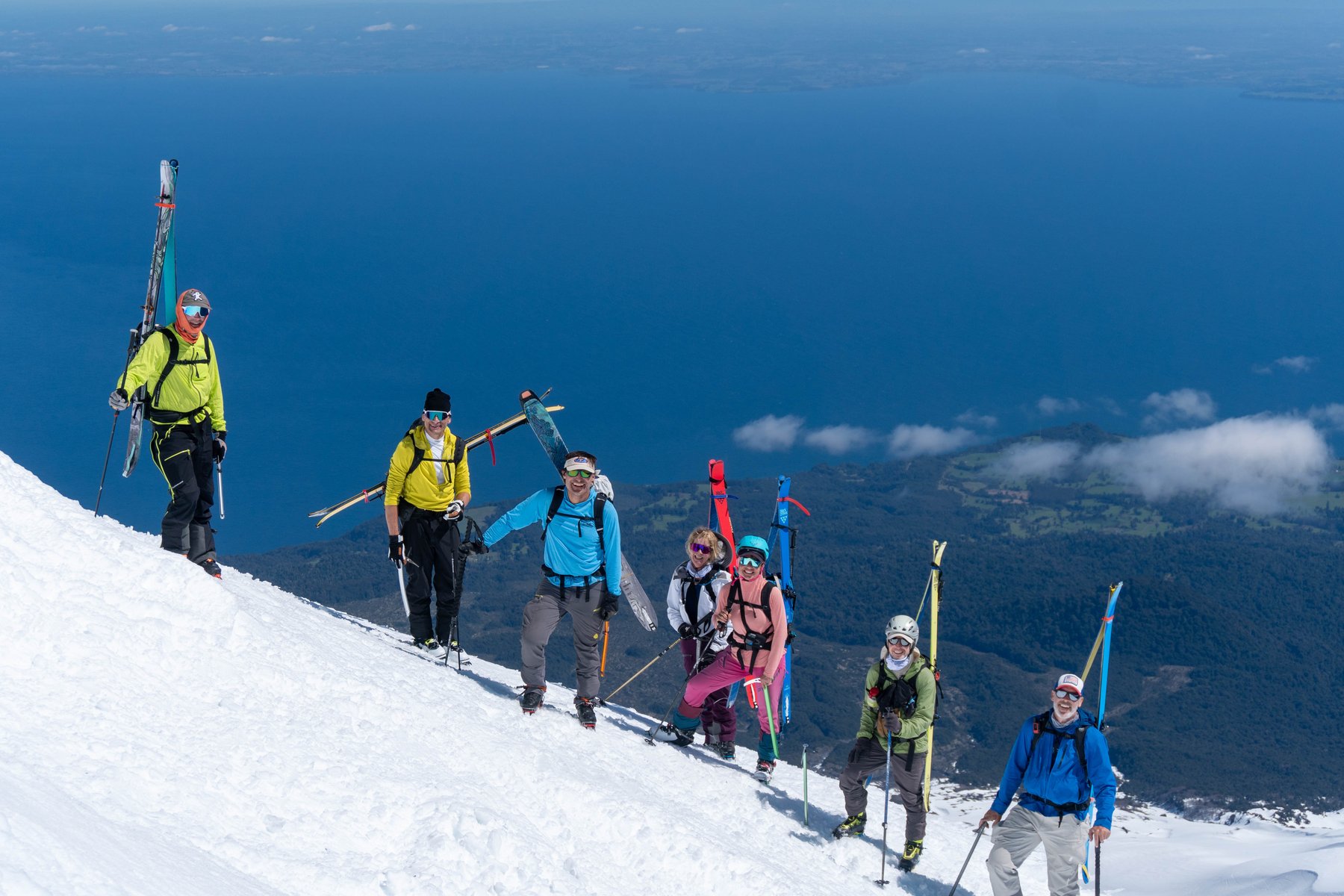
A typical day starts early. You skin up from the treeline through the araucaria forest, then onto the open cone. Slopes are usually 25 to 35 degrees. Depending on the volcano and conditions, a day can mean around 1,000 to 1,500 m (3,300 to 5,000 ft) of climbing.
Near the top, the snow can turn to wind-packed ice, and ski crampons or boot crampons may be needed. On Villarrica, the guide decides how close to the crater the group goes, based on wind and volcanic gas. Then comes the reward: a long, uninterrupted descent back to the trees.
When the schedule allows, the day ends in natural hot springs before dinner at the lodge.
Part 04
How hard is it?
Volcano touring is physically demanding but not highly technical. You need to:
- Ski confidently on 30-degree slopes in variable snow.
- Skin uphill for several hours, several days in a row.
- Be comfortable on firm, icy snow in the morning.
If you have done a few backcountry days at home, you are probably ready. If you are not sure, read What Level Do You Need for Backcountry Skiing in the Andes? or ask us.
Part 05
Gear you need
- Touring skis or a splitboard, with skins
- Ski crampons (and boot crampons if the guide asks)
- Avalanche beacon, shovel and probe
- Backpack and layers for wind, sun and cold
- Glacier glasses and high-SPF sunscreen: the spring sun at altitude is strong
We can rent touring gear with advance notice.
Part 06
Access and safety
These are active volcanoes. Access can be restricted depending on the volcanic alert level (set by SERNAGEOMIN) and national park rules (CONAF), and plans can change. Our guides check conditions every day and choose the volcano with the best snow, weather and access.
Part 07
Two ways to ski the volcanoes with us
- Iconic Volcanoes: 8 days, lift-free, Lonquimay, Llaima and Villarrica, groups of 3 to 6 with a 1:4 guide ratio. From USD 4,200. Pick-up and drop-off at Temuco airport.
- Nevados de Chillán & Corralco: 8 days, half resort, half touring. A good choice if you want lifts and volcano terrain in the same trip. From USD 4,900.
FAQ
Frequently Asked Questions
Can you ski Villarrica volcano?
When is the best time to ski Chile's volcanoes?
Do I need a guide to ski the volcanoes?
Can I splitboard the volcanoes?
What airport do I fly into?
Plan Your Trip
Ski the Andes With Local Guides
See dates and details for the Iconic Volcanoes trip.